
Arabic Language
The Department of Arabic Language at the College of Basic Education, Salahaddin University – Erbil, was established in 2012, initially offering evening classes. In 2018, the department expanded to include morning classes, continuing its path of growth and development. The department offers a comprehensive curriculum covering various aspects of the Arabic language and its literature, including translation, conversation, academic writing, and modern linguistic communication methods.
Since its inception, the department has played a pioneering role in Arabic language education, offering a comprehensive four-year Bachelor of Arts program.
Driven by a commitment to excellence in education and scientific research, the department provides undergraduate programs that equip students with the knowledge and skills necessary to excel in academic, linguistic, and literary fields. By integrating theoretical education with practical application and research opportunities, students gain in-depth practical experience in the study of Arabic language, its sciences, and literature.
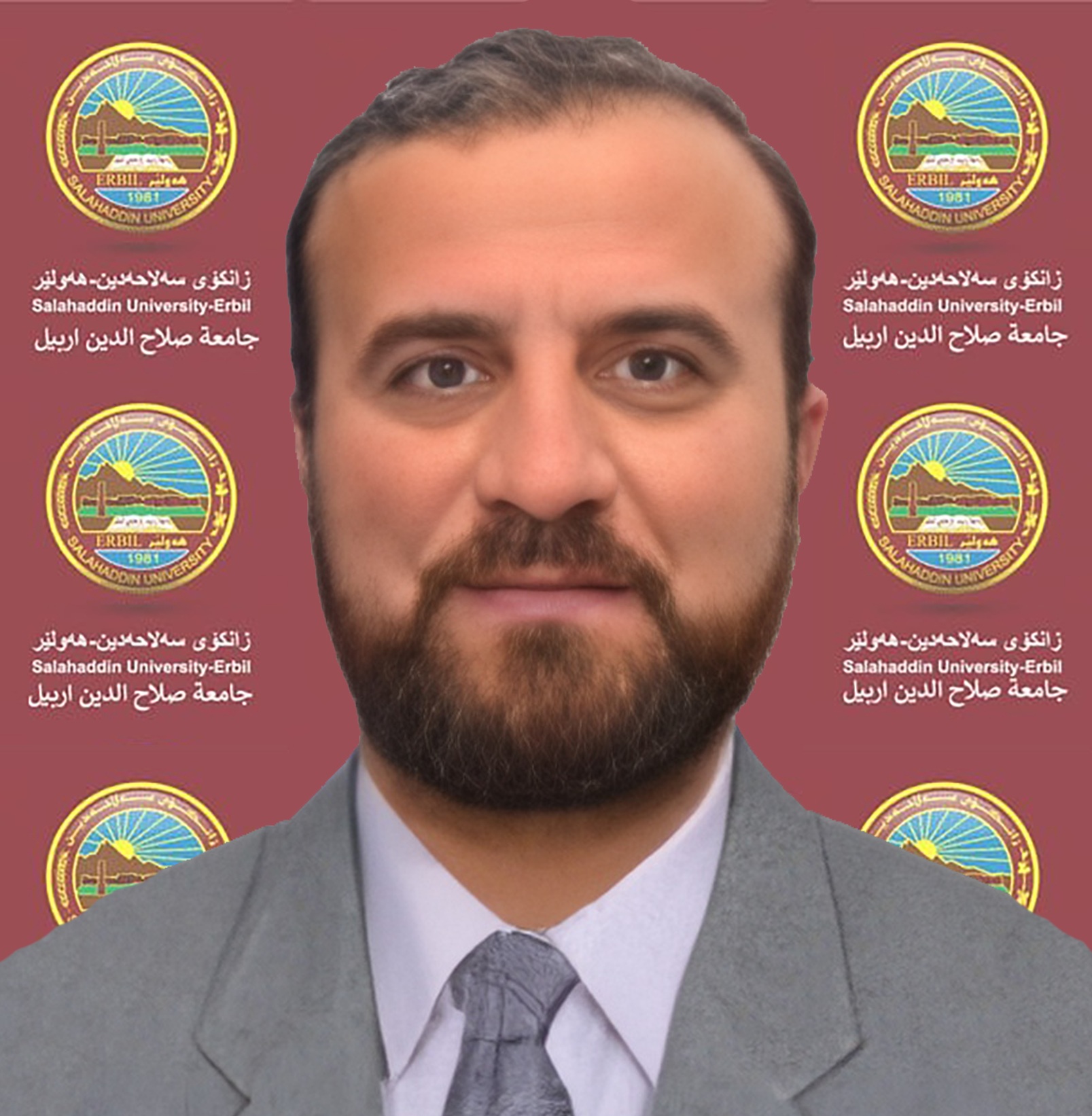
Full Name: Dr. Yaseen Tahseen Kareem Al-Baharki
Academic Title: Assistant Professor
Date of Birth: 1979
Place of Birth: Erbil – Baharka
Religion: Muslim
Ethnicity: Kurdish
General Specialization: Islamic Studies
Specific Specialization: Comparative Principles of Islamic Jurisprudence (Usul al-Fiqh al-Muqaran)
Occupation: University Lecturer Workplace: Salahaddin University – College of Basic Education – Department of Arabic Language
Phone Numbers:
+964 751 807 8767
+964 773 407 8767
Assistant Professor Dr. Yaseen Tahseen Kareem Al-Bahrki, I was born in 1979. I hold a bachelor’s degree from the Department of Islamic Studies, University of Baghdad in 2003-2004, with a very good grade.
In the same department I obtained a master’s degree in 2007 in the principles of comparative jurisprudence and the investigation of manuscripts with distinction. I obtained a doctorate in the year (2012) in the principles of comparative jurisprudence in the language Arabic with distinction.
I have been teaching since 2007, so I studied at Soran University for six years in the Department of Arabic Language, then transferred my service to Salahaddin University - College of Basic Education - Department of Arabic Language, since 2015, and my academic title rose to Assistant Professor in 2021.
I have seven Research published in international and Iraqi journals, and participated in a number of conferences.
The mission of the Department of Arabic Language is to provide high-quality education that fosters creativity, innovation, and critical thinking in the field of Arabic language and literature. We aim to equip students with a comprehensive and profound understanding of Arabic language skills, ranging from grammar and morphology to expression, classical and modern Arabic literature, translation, academic writing, and modern communication methods.
Through the integration of theory, practice, and scientific research, we prepare graduates to face contemporary challenges, contribute to the development of linguistic and literary thought, and serve the cultural and humanistic community. Our commitment to educational and research excellence ensures that our students are linguistically proficient, socially and intellectually responsible, and capable of contributing effectively to building a cultural and civilized society.
VisionThe Department of Arabic Language at the College of Basic Education – Salahaddin University aspires to be a leading center in education, research, and innovation in the Arabic language and literature across the region. Through an inspiring educational environment that combines intellectual development and creativity, we aim to prepare future leaders in Arabic studies who can respond to the challenges of the times and engage with the evolving cultural and academic landscape.
We are committed to continuously developing curricula and research initiatives that align with modern requirements and societal needs, ensuring that graduates possess the linguistic and literary competencies necessary to contribute meaningfully to Arab culture and preserve its identity. We also aim to promote interdisciplinary research and community engagement, inspiring our students toward lifelong learning and the ethical application of linguistic and literary knowledge.
Graduates of the Department of Arabic Language will be able to:
- Master the four language skills (reading, writing, speaking, and listening), with the ability to express ideas using diverse literary and stylistic techniques suitable for different contexts.
- Analize literary and linguistic texts from various historical periods using diverse critical approaches, and extract meanings, ideas, and rhetorical significance.
- Apply grammatical, morphological, and phonological rules accurately in writing, and correct linguistic errors in speech and writing.
- Understand and interpret linguistic phenomena and literary texts through scientific research methods, contributing to the advancement of linguistic and literary knowledge.
- Use translation and interpretation skills to accurately convey meaning between Arabic and other languages, respecting cultural and stylistic differences.
- Design and organize linguistic and literary research projects, utilizing scientific methodology for data collection and analysis.
- Develop academic writing skills, including essays, reports, and research papers, while adhering to principles of scientific integrity and academic honesty.
- Use modern technological tools in learning and teaching Arabic, along with relevant applications for research and writing.
- Understand the historical development of the Arabic language and its impact on literary and cultural texts and relate these changes to social and cultural transformations.
- Apply effective communication skills in educational, media, and cultural contexts, and deliver lectures, seminars, and speeches clearly and coherently.
- Participate in academic, cultural, and research activities that enrich knowledge and strengthen the role of Arabic in society.
The Department of Arabic at the College of Basic Education – Salahaddin University-Erbil maintains a strong partnership with the Ministry of Education, providing students with the opportunity to gain practical experience through teaching internships in public schools. Additionally, students participate in an extended school-based observation program, where they regularly visit schools throughout an academic semester to observe and learn from experienced teachers in real classroom settings.
The department aspires to expand its collaborative efforts by establishing future partnerships with local and international educational institutions, aiming to support professional development and enrich students’ learning and training experiences, thus preparing academically and pedagogically qualified graduates.
Degree Program Overview
The Department of Arabic at the College of Basic Education – Salahaddin University-Erbil offers a Bachelor's degree in Arabic Language.
Key features of the academic program include:
- Core Courses: These include subjects such as grammar and linguistics, classical and modern Arabic literature, rhetoric, prosody, literary criticism, philology, and various branches of linguistics. In addition, students take educational and pedagogical subjects such as educational psychology, measurement and evaluation, and methods of teaching Arabic.
- Elective Courses: These may include subjects like comparative literature, sociolinguistics, text analysis, special education, and advanced writing and expression skills.
- Graduation Research Project: In the final academic year, students are required to complete a graduation research project within the department’s specialization, aiming to enhance their academic and research skills.
Postgraduate Studies
In department of Arabic Language at Salahaddin University-Erbil postgraduate studies does not exists
Program Learning Outcomes
Graduates of the Department of Arabic at the College of Basic Education – Salahaddin University-Erbil, upon successful completion of the Arabic Language program, are expected to achieve the following learning outcomes:
- Comprehensive Knowledge
- Demonstrate a broad and deep understanding of Arabic language principles, including grammar, morphology, rhetoric, classical and modern Arabic literature, literary criticism, and linguistic and cultural history. This includes a solid knowledge of Arabic heritage and its diverse styles.
- Critical Thinking and Problem-Solving
- Apply critical thinking and literary analysis skills to study, evaluate, and interpret texts, with the ability to propose new critical insights contributing to the advancement of Arabic studies.
- Research and Academic Proficiencyt
- Master research skills, including sourcing, text analysis, and producing scholarly works methodically and proficiently.
- Ethical and Professional Conduct
- Adhere to the highest standards of academic ethics and integrity in studies and writing, respecting intellectual property rights.
- Effective Communication
- Communicate effectively in both Arabic and English within academic and educational contexts through scholarly writing, oral presentations, and engagement with academic and cultural audiences.
- Career Readinesst
- Be prepared to work in education, research, publishing, and cultural services, with the ability to contribute to curriculum development and teaching methods.
- Lifelong Learning and Adaptabilityt
- Engage in continuous learning to update knowledge and skills and adapt to developments in language, literature, and education fields.
- Research Skillst
- Conduct independent academic research that enriches Arabic knowledge, with the capacity to pursue advanced studies and specialized research careers.
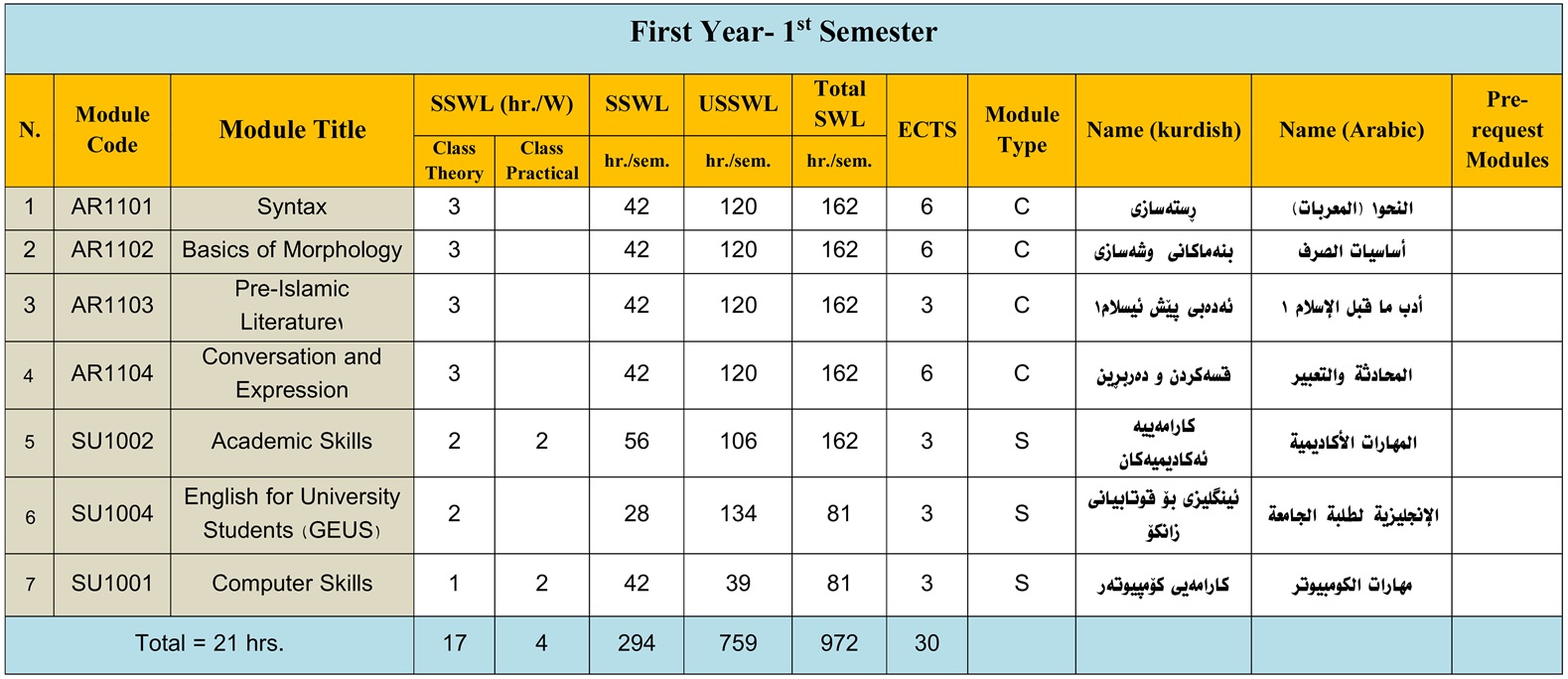
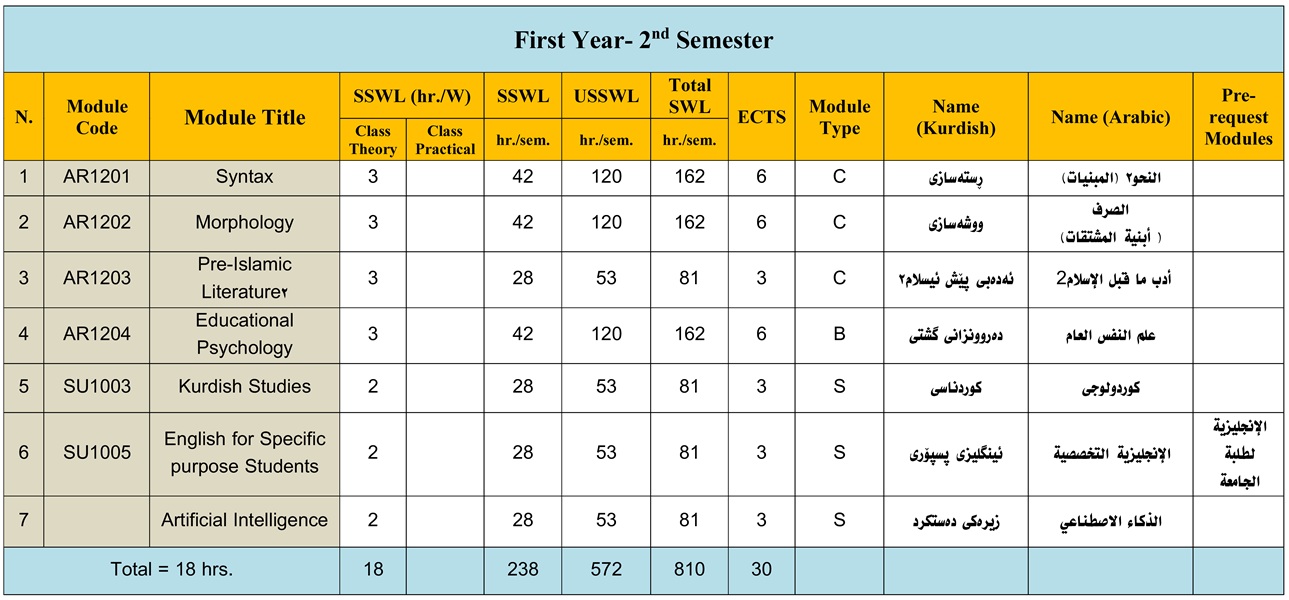
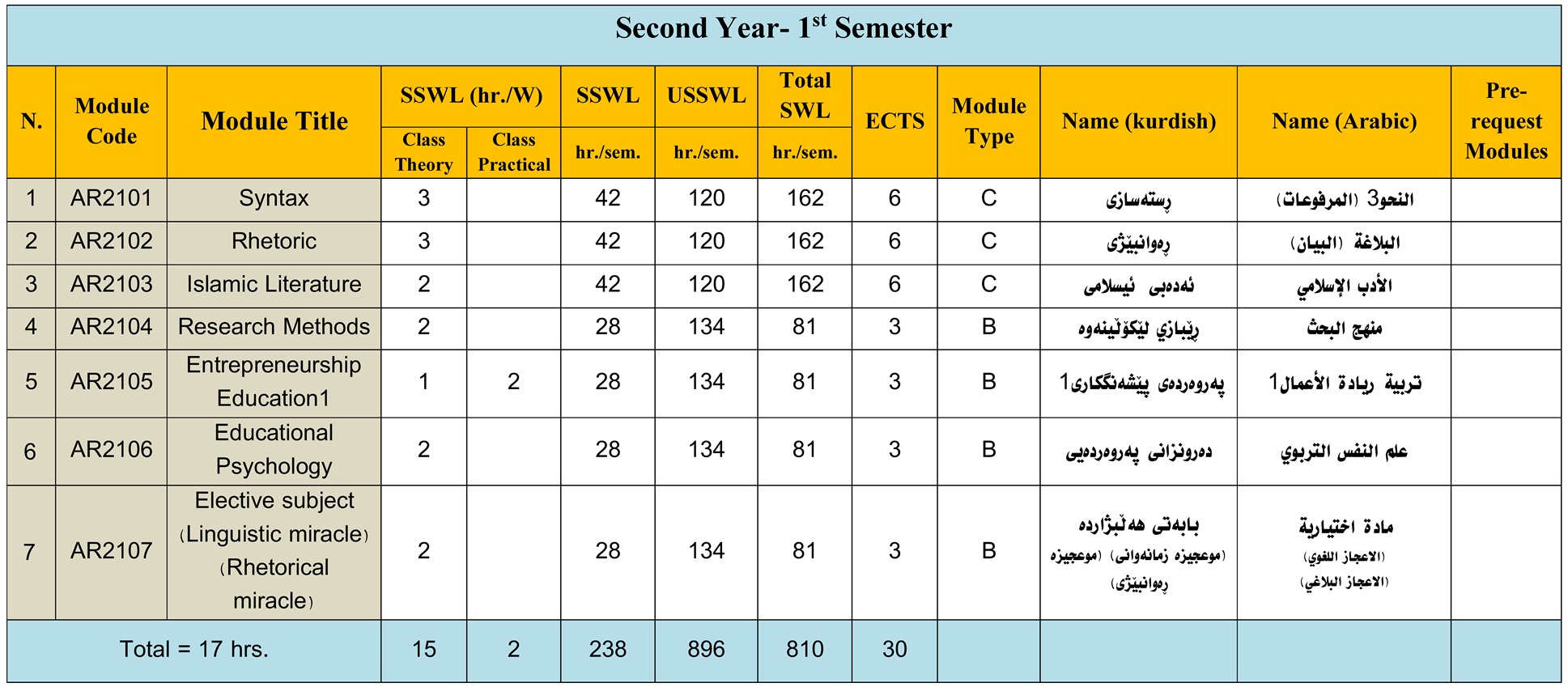
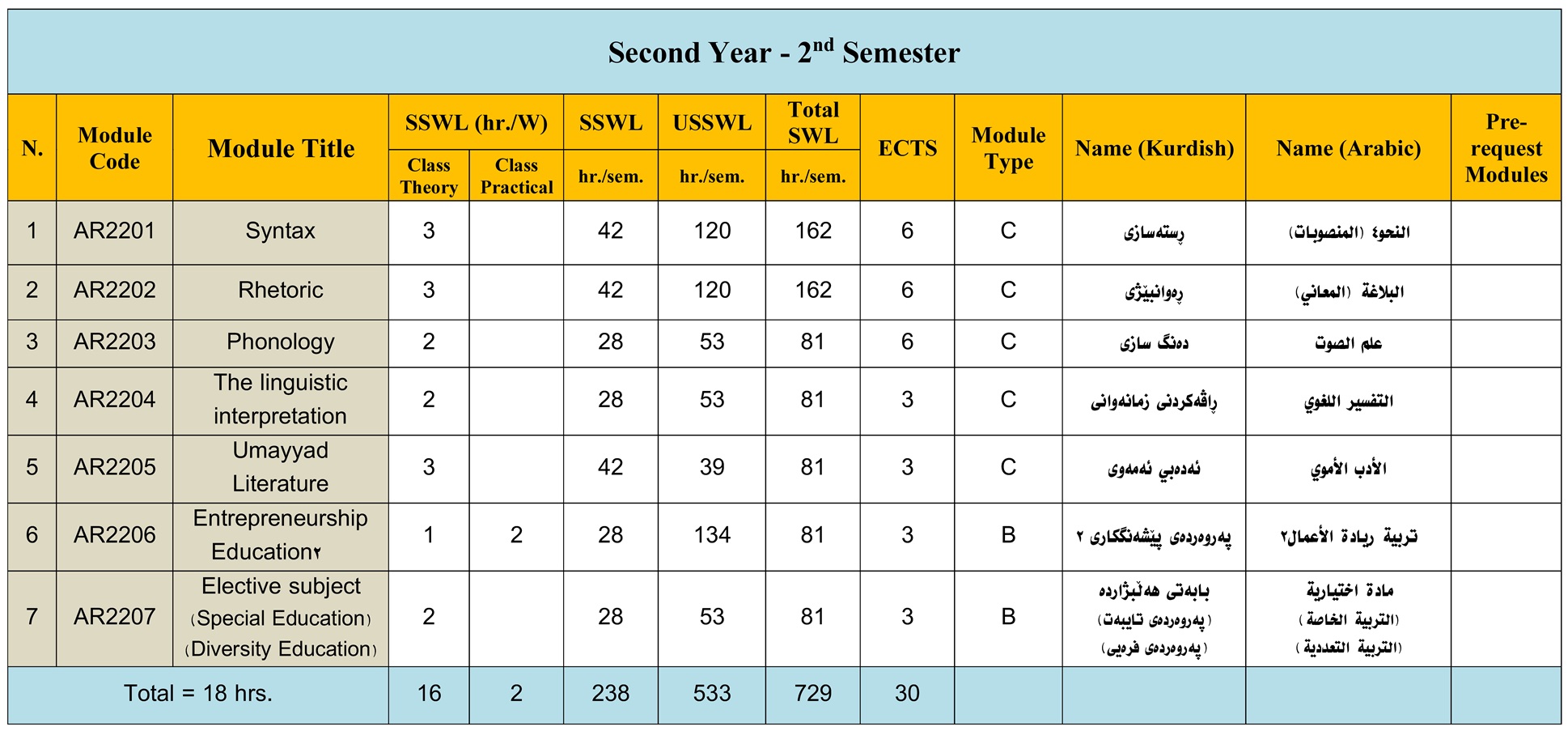
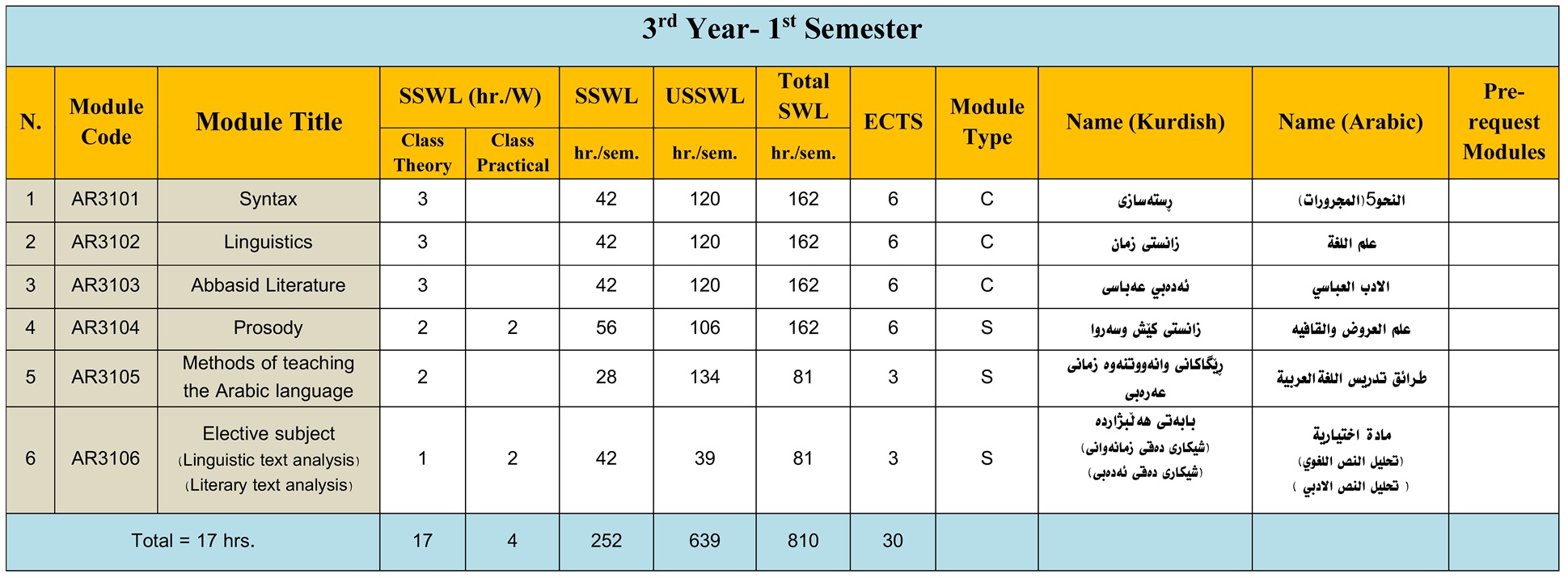
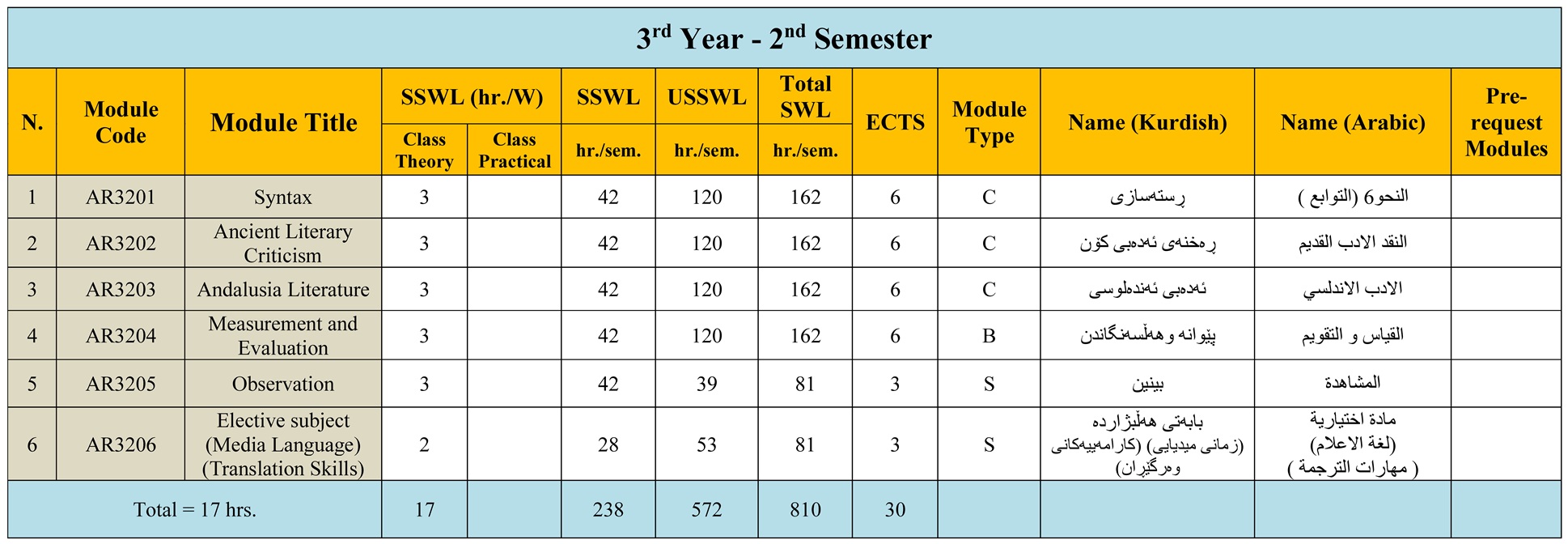
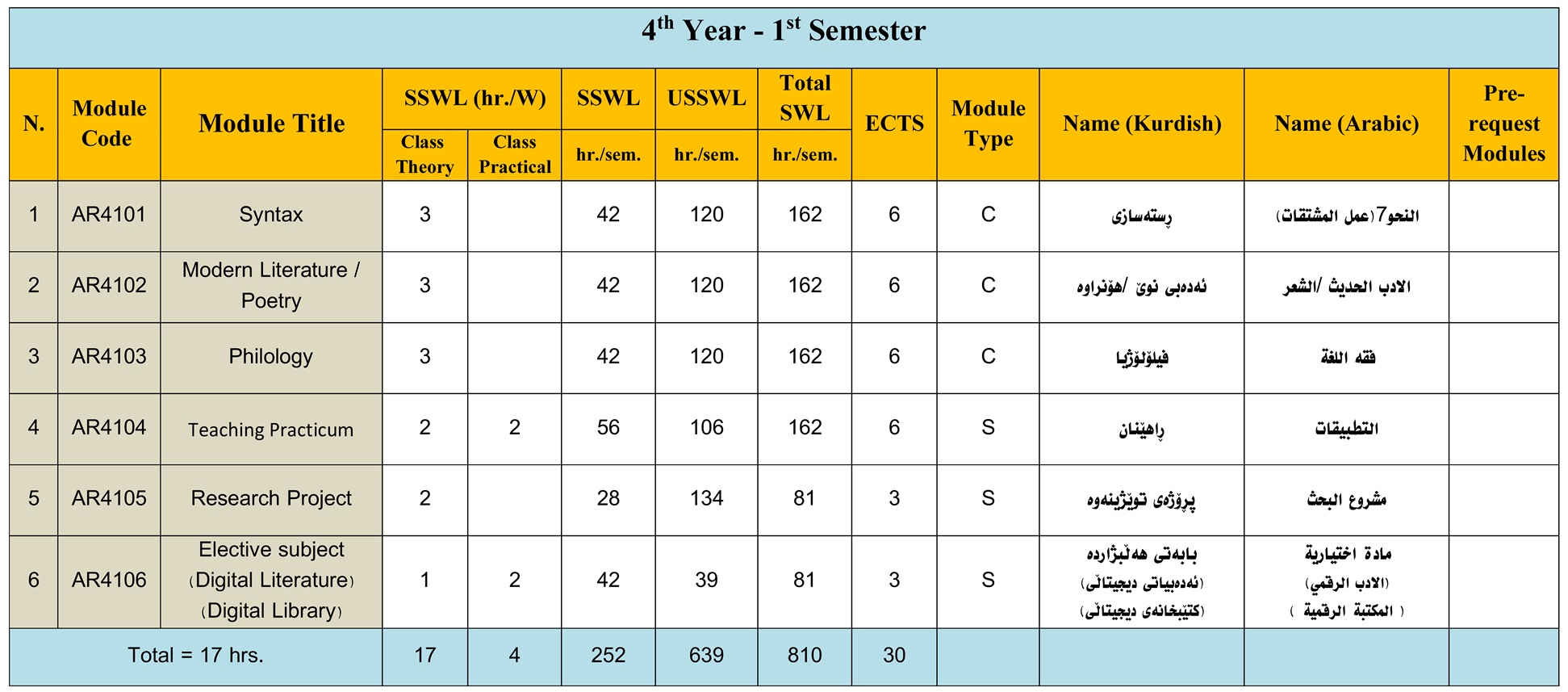
Bachelor's degree (B.A.) in Arabic Language (First Cycle)
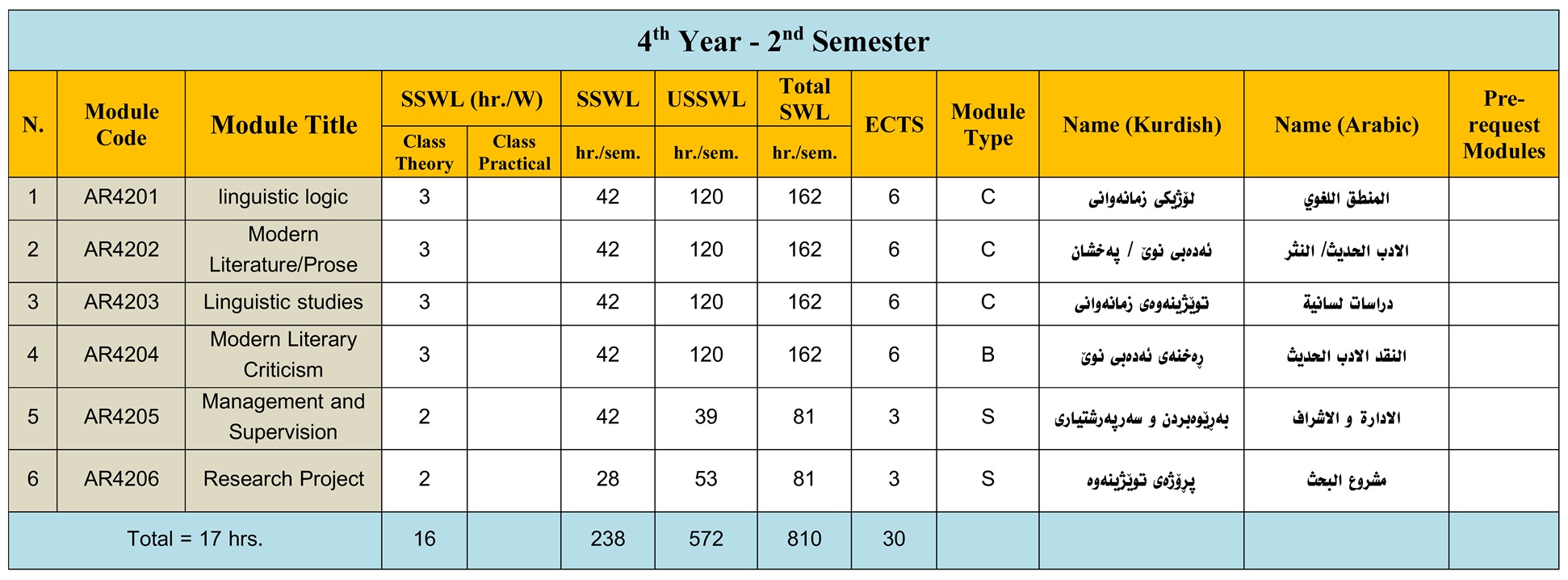
Four Year's Curriculum Program, 240 ECTS Credits, 1 ECTS = 27hrs.
Admissions
The Department of Arabic at the College of Basic Education – Salahaddin University-Erbil offers two study options for prospective students to ensure accessibility and flexibility based on individual circumstances:
- Government-Funded Study (Zankoline)
- Description:
- This option provides free education for students who meet the admission criteria and are accepted through the centralized admission system known as "Zankoline."
- Eligibility:
- Applicants must meet the academic requirements set by the Ministry of Higher Education and Scientific Research.
- Admission is based on high school grades, focusing on subjects related to Arabic language and literature.
- Benefits:
- Exemption from tuition fees.
- Full access to university facilities and services, including libraries and cultural and scientific activities.
- Opportunity to benefit from scholarships and various government initiatives.
- Parallel Study (Self-Funded)
- Description:
- This option allows students who did not secure a seat through Zankoline to pursue their studies by paying tuition fees.
- Tuition Fee:
- 1,500,000 IQD per year.
- Eligibility:
- Students must meet the minimum admission requirements for the Department of Arabic.
- This option offers students the chance to continue their academic education by paying tuition fees.
- Benefits:
- Access to the same quality education, resources, and facilities as Zankoline students.
- Enables students to achieve their academic goals without being limited by centralized admission quotas.
- Academic Qualifications:
- Completion of high school with a focus on subjects related to Arabic language and literature.
- Achieving the minimum GPA determined by the Ministry of Higher Education and Scientific Research.
- Application Process:
- Zankoline (Government-Funded):
- Apply through the centralized Zankoline admission system.
- Submit required documents, including high school transcripts, national ID, and other certificates as per application guidelines.
- Parallel Study (Self-Funded):
- Apply directly to the Department of Arabic for parallel study.
- Submit required documents along with tuition fee payment details.
- Zankoline (Government-Funded):
The Department of Arabic at the College of Basic Education – Salahaddin University-Erbil has produced approximately 200 graduates in recent years. Many of these graduates have gone on to pursue careers in teaching, educational support, and cultural and academic fields across both the public and private sectors.
Graduate Employability
The Department of Arabic is dedicated to preparing its graduates one academic level—Bachelor’s with the knowledge, skills, and experience necessary to succeed in diverse career paths. Our graduates are fully prepared for opportunities in academic institutions, government sectors, cultural organizations, and more, with an emphasis on contributing to scientific progress and community development.
Career Opportunities for Bachelor of Arts (B.A.) in Arabic Language Graduates
Career Paths:
- Arabic language teachers in public and private schools
- Educational program facilitators
- Private tutoring
- School administration and educational leadership
- Academic quality controllers in schools
Employability Skills:
- Strong knowledge of the Arabic language subject
- Effective teaching and classroom management skills
- Communication and interpersonal skills
- Curriculum and educational program design
- Assessment and evaluation
- Lifelong learning skills
- Collaboration and teamwork
- Adaptability and innovation
Academic Advising
Academic Advising Services
Our academic advising services include:
- Guidance on course registration and selection
- Academic planning and progression towards completing undergraduate or postgraduate degrees
- Support for students facing academic difficulties
Currently, advising services are offered in person within the department. Students are encouraged to proactively seek support to stay on track and make informed academic decisions.
Internship Opportunities
The Department of Arabic has an official partnership with the Ministry of Education to provide structured internship experiences for students. These include:
- A one-month teaching internship in public primary schools
- A semester-long school observation program where students visit and learn from experienced teachers
All internships are unpaid and conducted in public schools, offering students direct exposure to real classroom environments and teaching responsibilities.
- Benefits of Internships
- Internships are a vital part of teacher preparation. They allow students to:
- Apply theoretical knowledge in real classroom settings
- Improve teaching skills and build confidence
- Develop professional relationships with practicing teachers and school administrators
- Enhance employability through practical experience, often leading directly to job offers
- Types of Internship Opportunities
- Currently, all internship opportunities focus on teaching and are arranged through the Ministry of Education. Internships are only carried out in public schools, and no additional types of internships are offered at this time.
- How to Apply for Internships
- Students are required to submit a formal application to the department. Once approved, they are directed to schools where they obtain acceptance. The department provides students with an official support letter to facilitate their placement.
- The head of department and academic coordinator manage and oversee the internship process.
Career Services
The Department of Arabic Language and Literature supports students and graduates in entering the job market or pursuing postgraduate studies through:
- Career counseling sessions to help define pathways in education, media, translation, or cultural work.
- Job readiness workshops covering communication skills, résumé writing, and interview preparation.
- Networking events with alumni and professionals to expand professional connections.
- Assistance with postgraduate applications locally and internationally, including research and application guidance.
- Encouragement of cultural entrepreneurship, including writing and digital publishing projects.